
TCP part 3
Last week:
the Internet’s service abstraction as a host-to-host datagram
Build on top of that: User Datagram
Reliable services on top of User Datagram: host, DNS, DHCP, … (idempotent short get)
TCP: convert datagrams to reliable byte streams
Sender Message: first_index, data, FIN
Receiver Message: next needed index, window size
“User Datagram” info (for multiplexing, and part of the TCP datagram port): source port (16 bits), destination port (16 bits), checksum
Internet datagram (v4): source address(32 bits), destination address (32 bits), checksum
source IP + source port + destination IP + destination port define a connection
There can be [公式] simultaneous connections from one computer.
e.g. ByteStream: “abcdef”
- Sender message: {
first_index=0, data: “abcdef”,FIN=true} - Or {
first_index=0, data=”abcdef”,FIN=false} and {first_index=6, data:””,FIN=true} - Receiver message: {
next_needed=6,window_size=0}, {next_needed=6,window_size=3} (FIN**** flag also consumes a sequence number}, {next_needed=7,window_size=2} - Ordering of messages:
- sender: {
first_index=0, data=”abcdef”, FIN=false} - receiver: {
next_needed=6, window_size=0} - After the reader pops 3 bytes: {
next_needed=6, window_size=3} - sender: {
first_index=6, data:””, FIN=true} - receiver: {
first_index=6, data:””, FIN=true}
- sender: {
What happens when a stream ends?
My sender has ended its outgoing bytestream, but the incoming bytestream from the peer may not be ended.
When a stream ends, can the same pair of ports be used? Reusing the same pair of ports makes it not clear to tell whether a datagram belongs to the old stream or the new stream.
We want a new INCARNATION of the connection (new connection on the same pair of ports)
Sequence number: start from a random big number + **SYN**: this sequence number should be viewed as the beginning of a stream
- If the sequence number doesn’t make sense on the old stream, and the SYN flag is true, the receiver knows this is a new incarnation of the connection.
- e.g. {
sequnce_no=12345, data=”abcdef”, SYN=true, FIN=true}, and {sequence_no=99999, data=”xyz”,SYN=true, FIN=true}
First seqno belongs to SYN flag, next seqnos belong to each byte of stream, final seqno belongs to FIN flag.
- It is very important to have
SYNflag andFINflag delivered reliably, so therefore receiver need to acknowledge SYN seqno and FIN seqno
Three-way Handshake
What happens to TCP receiver message’s next_needed_idx field before receiving the SYN flag from the peer?
Without seqno:
- I: {{
first_index=0, data=”abcdef”, FIN=true}, {next_needed=0, window_size=1000}} - Peer: {{
first_index=0, data=””, FIN=true}, {next_needed=7, window_size=1000}} - I: {{
first_index=7, data=””, FIN=false}, {next_needed=1, window_size=1000}}
With seqno and SYN:
- I: {{
seqno=12340, SYN=true, data=”abcdef”, FIN=true}, {What should this be? (before seeing 9999 from the Peer)}} - Peer: {{
seqno=9999, SYN=true, data=””, FIN=true}, {next_needed=12348, window_size=1000}} - I: {{
next_needed=10001, window size =1000}}
ackno = optional<int> (a pair of ACK flag and ackno int)
- I: {{
seqno=12340, SYN=true, data=”abcdef”, FIN=true}, {ACK=false, ackno={missing}, window_size=1000}} (SYN) - Peer: {{
seqno=9999, SYN=true, data=””, FIN=true}, {ACK=true, ackno=12348, window_size=1000}} (SYN+ACK) - I: {{
ACK=true, ackno=10001, window size =1000}} (ACK)
(SYN) + (SYN+ACK) + (ACK) = “the three-way handshake”
What if the two SYN messages are sent at the same time?
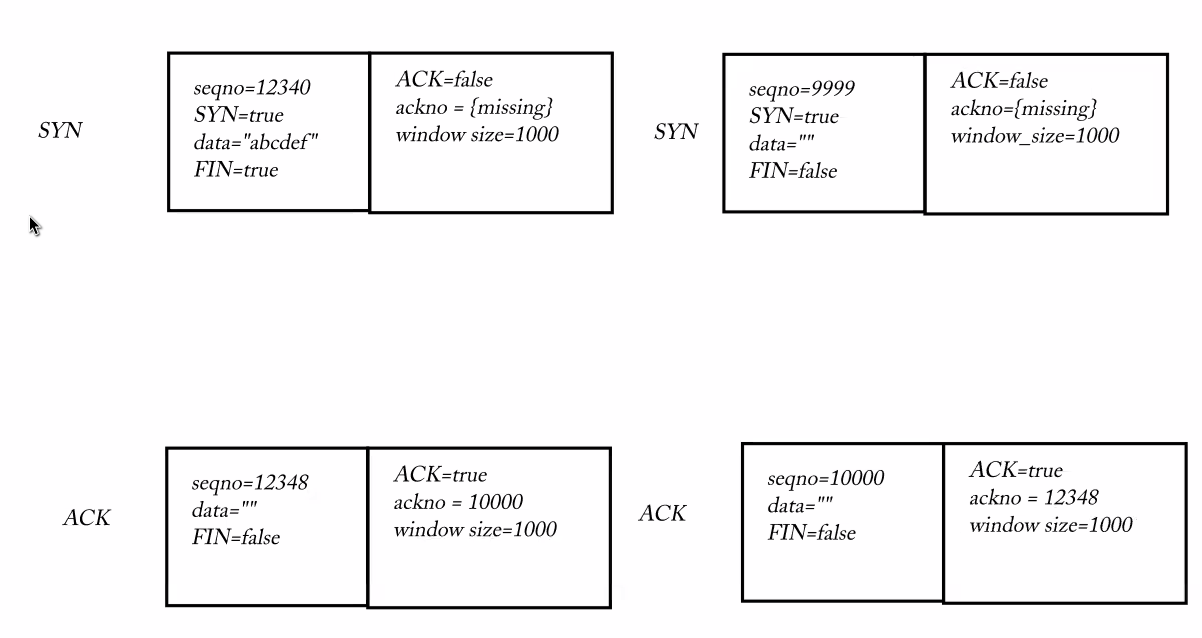
- Not a classic “three-way handshake” but still a valid way of starting a TCP connection.
Standardized TCP Message:
- Sender: {sequence number, SYN, data, FIN}
- Receiver: {ackno: optional<int>, window_size}
- “User Datagram” info
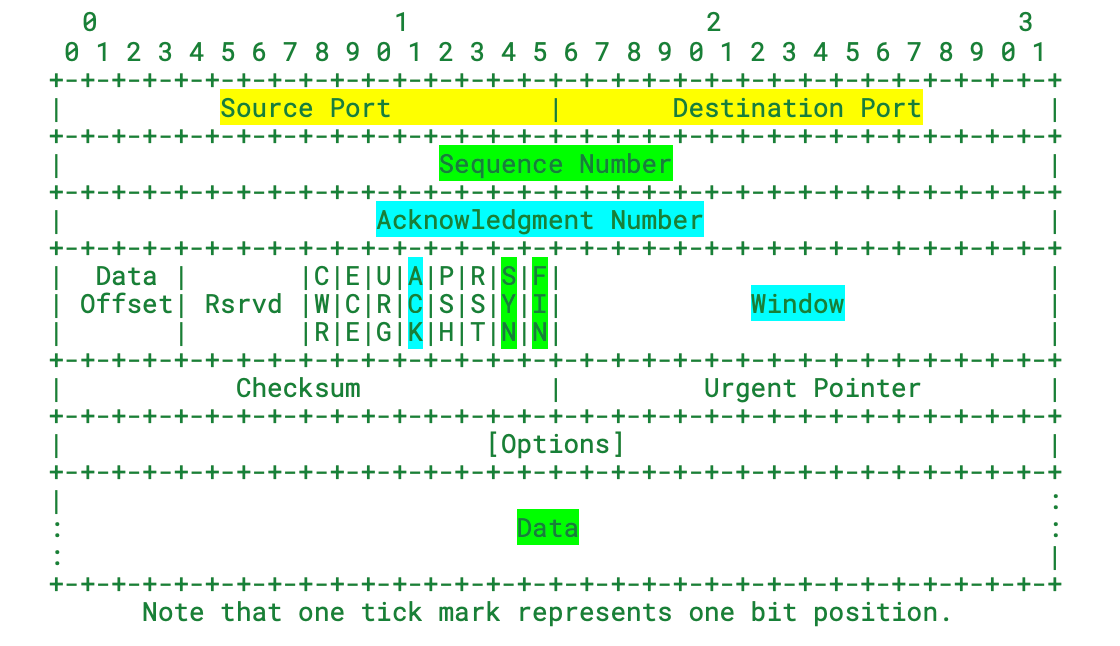
https://www.rfc-editor.org/rfc/rfc9293.html#name-header-format
    0                   1                   2                   3
    0 1 2 3 4 5 6 7 8 9 0 1 2 3 4 5 6 7 8 9 0 1 2 3 4 5 6 7 8 9 0 1
   +-+-+-+-+-+-+-+-+-+-+-+-+-+-+-+-+-+-+-+-+-+-+-+-+-+-+-+-+-+-+-+-+
   |          Source Port          |       Destination Port        |
   +-+-+-+-+-+-+-+-+-+-+-+-+-+-+-+-+-+-+-+-+-+-+-+-+-+-+-+-+-+-+-+-+
   |                        Sequence Number                        |
   +-+-+-+-+-+-+-+-+-+-+-+-+-+-+-+-+-+-+-+-+-+-+-+-+-+-+-+-+-+-+-+-+
   |                    Acknowledgment Number                      |
   +-+-+-+-+-+-+-+-+-+-+-+-+-+-+-+-+-+-+-+-+-+-+-+-+-+-+-+-+-+-+-+-+
   |  Data |       |C|E|U|A|P|R|S|F|                               |
   | Offset| Rsrvd |W|C|R|C|S|S|Y|I|            Window             |
   |       |       |R|E|G|K|H|T|N|N|                               |
   +-+-+-+-+-+-+-+-+-+-+-+-+-+-+-+-+-+-+-+-+-+-+-+-+-+-+-+-+-+-+-+-+
   |           Checksum            |         Urgent Pointer        |
   +-+-+-+-+-+-+-+-+-+-+-+-+-+-+-+-+-+-+-+-+-+-+-+-+-+-+-+-+-+-+-+-+
   |                           [Options]                           |
   +-+-+-+-+-+-+-+-+-+-+-+-+-+-+-+-+-+-+-+-+-+-+-+-+-+-+-+-+-+-+-+-+
   |                                                               :
   :                             Data                              :
   :                                                               |
   +-+-+-+-+-+-+-+-+-+-+-+-+-+-+-+-+-+-+-+-+-+-+-+-+-+-+-+-+-+-+-+-+
Note that one tick mark represents one bit position.