
TCP part 2
Stacks of service abstraction
Short gets (DNS, DHCP) -> Use datagrams -> Internet Datagrams
Byte Stream –(TCP)--> User datagrams -> Internet Datagrams
- Web requests/responses (HTTP) -> Byte Stream Youtube/Wikipedia -> Web requests/responses
- Email sending (SMTP) -> Byte Stream
- Email receiving (IMAP) -> Byte Stream
Multiplexing ByteStream
“u8 u8” (Which byte stream; what is the byte)
- Any reading and writing of one byte would be actually two bytes, the first byte for which byte stream and the second for the actual byte
“u8 u8 {u8 u8 … u8}” (which byte stream; size of payload; sequence of characters of the string chunk)
- Any reading and writing of n bytes would be actually n + 2 bytes
- Tagged byte stream: HTTP/2 | SPDY
How to make ByteStream push idempotent?
TCP Sender Message
first_index- data
FIN
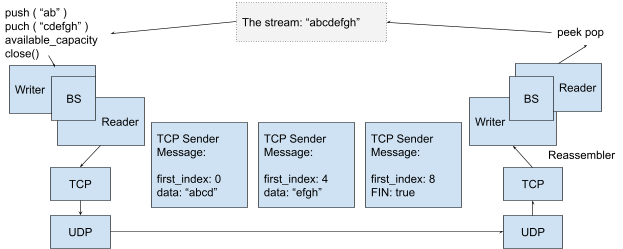
This works for out-of-order or multiple deliveries. Since UDP has a checksum field, altered TCP Message would be ignored on the UDP layer.
What if datagrams are missing?
- How does the sender know that a datagram needs to be sent multiple times?
- DNS/DHCP: if we don’t receive an answer, then we retransmit. But such response/answer does not exist in
pushing(void push())
Acknowledgement
TCP Receiver Message
- “
A B C D E F G” each byte sent as a separate TCP sender message, and “D” is not received. - “I got the sender message with
first-index = 2,length = 1.”- Valid but more work. There will be one receiver message for each sender message.
- “Got anything? Y/N. Next needed:
#3.”- Acknowledgements are accumulative, and that make life simpler.
- Give FIN flag a number: “A B C D E F G FIN”.
TCP Sender Message: {sequence number, data}
TCP Receiver Message: {Next needed: optional<int>} and TCP Receiver Message {Next needed: optional(8)} would mean FIN is received.
TCP Receiver Message: {Next needed: optional<int>; available capacity:int}
- {
Next needed: optional(3);available capacity: 2} === Receiver wants to here about “DE”. - “DE” is the window. (Red area in that picture of lab 1)
TCP Receiver Message: {Ack no: optional<int>; window size: int}
TCP Segment
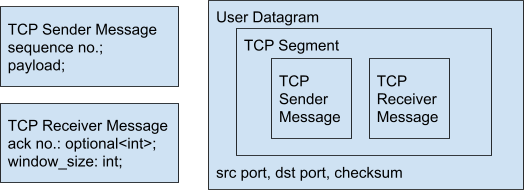
This is the service abstraction that TCP is providing:

And this is what happens under the hood (and also what you will be implementing in the labs)

Rules of TCP
Reply to any nonempty TCP Server Message