
Service abstractions, stacks, and reliability
Service abstractions
Last week: best effort datagram - IP implementation
IP impl: (destination IP address, payload) -> Internet datagram {src IP address, dst address, TTL, payload, protocol}
Best-effort delivery
- Delivered once
- Never delivered
- Delivered n > 1 times
- Delivered with altered or truncated payload
- Delivered to wrong destination
- Delivered after another datagram that was sent later
User datagram protocol impl: (dst IP address, dst port #, payload) (UDPSocket::sendto(...))-> User datagram {contains src port, dst port, payload} (becomes payload of IP impl input)
Both provides best-effort delivery of datagrams (“unreliable”)
- The fundamental difference between UDP and IP is that UDP is port-to-port (between unprivileged user programs) and IP is host-to-host/computer-to-computer (entities have internet addresses),
- UDP and IP are in the OS kernel, but whatever that is on the top of UDP can be in user-space. Unprivileged user programs would not affect each other if the OS assigns a different port address to each user programs.
Q: what if datagrams are altered during transmission?
A: UDP and IP have light checksum field for detecting alteration, and delivery to a wrong destination is something that could happen under “best-effort”.
Q: how does Firefox know which dst port to send UDP to?
A: This is the same as how Firefox knows the dst IP address. (this question is deferred to later lecture)
(/etc/protocols: protocol index, /etc/services: port number)
Q: how does Firefox know its own port number?
A: The OS kernel assigns a src port to Firefox that won’t conflict with any other user program.
Q: how does Firefox know the source address of incoming datagrams?
A: UDPSocket::recv: (src address &, payload &)
Q: Do I have to listen to the port as specified by /etc/services?
A: It is possible to run a service not on a well-assigned port number.
Protocol Stack
The protocol stack is a sequence of modules where each module only communicates with the layer 1-level upper and lower from it through service abstraction.
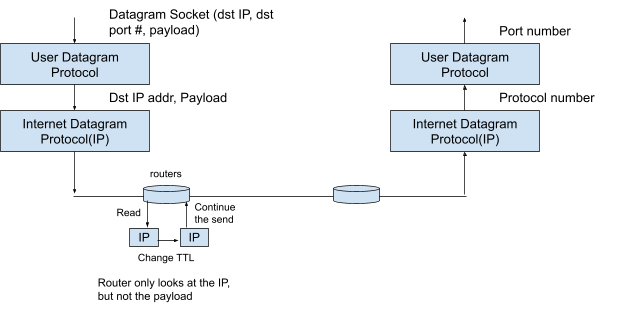
What can be built on top of UDP?
- Unreliable text messaging
- Voice over UDP (VoIP)
- IP over UDP (VPN: Virtual Private Network) Netflix -> UDP -> IP -> VPN Software -> UDP -> IP Some machine in France: VPN Software <- UDP <- IP, and send the upper-layer IP datagram over the Internet. When Netflix receives the datagram, it sees the
srcaddress as from France
Reliability
What if we want something more than “unreliable”? What if we want a “reliable retrievable short piece of data”?
- Asker: request -> response can be built on top of UDP. Asker keeps sending until it gets an answer. Asker would eventually returns a response, and is “reliable”
host cs144.keithw.orgis built as a user-program on top of UDP, and provides asker’s reliability (either returns or time-out)- For certain kind of requests, it is ok to make the request more than one time, but this is not the case for all requests.
- What is the difference between reliable retrieval (“
host cs144.keithw.org”) and reliable action (“Fire a torpedo”)? The kind of reliability that the service provides dictates how we design the service.