
手搓 Transformer(六):Decoder 拼装
前言
在前面几篇文章中,我们系统梳理了词向量位置编码Embedding层,注意力机制Multi-Head Attention层,归一化LayerNorm层,信息编码器Encoder层。本章将重要阐述Decoder部分内容。由于Decoder的masked self-attention,cross-attention,FFN三部分组件在前面都已经实现,所以我们主要讨论数据流动,以及具体的代码实现。
Decoder涉及到的参数与Encoder大部分一致,在此基础上多出了t_mask和s_mask,前者用于masked self-attention的掩码,后者用于cross-attention的掩码。关于二者张量的具体实现,会在下一篇Transformer的组装中具体阐述。Decoder的输入有两部分,一部分是已生成的词向量,形状为 \((B,L)\) ,记为dec_tokens;另一部分是Encoder编码后的信息向量,形状为 \((B,L,D)\) ,记为enc_x。Decoder的输出为解码后的信息向量,形状为 \((B,L,D)\) ,记为dec_x。
Decoder的核心作用是根据已生成的内容和Encoder的信息预测下一个 token
Decoder整体数据流
先从宏观结构入手
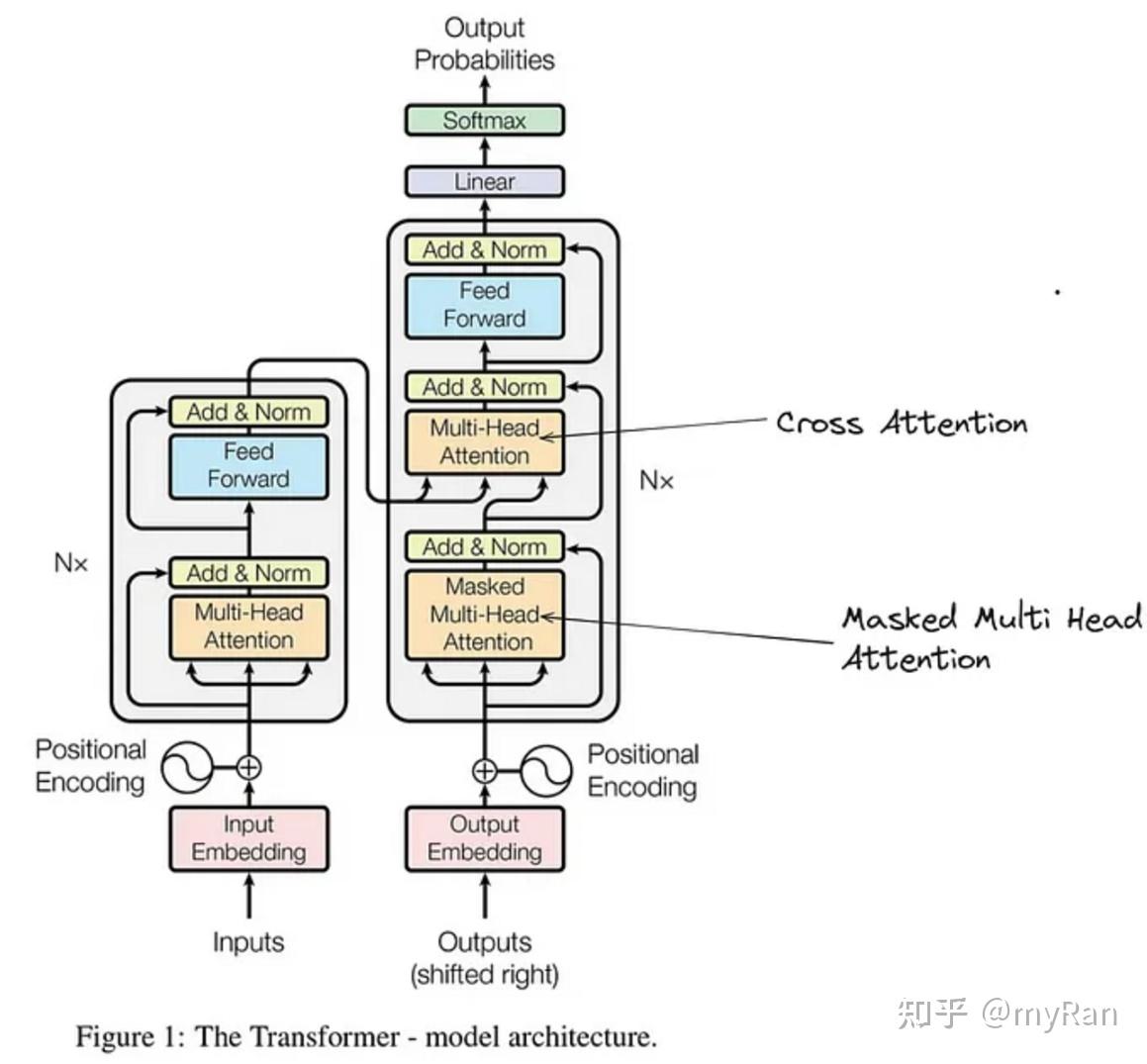
Transformer架构
Decoder的第一步和Encoder极其相似,需要经过Embedding,
将毫无意义的token_id转化为有一定意义的词向量。
Decoder第二步是多层DecoderLayer堆叠,这和Encoder也很类似,
区别在于DecoderLayer内部有三个组件,并且有两个不同的输入。每一层Decoder都包含Masked self-Attention, Cross-Attention,以及FFN。
DecoderLayer
先展示代码:
# Module5: Decoder
# DecoderLayer -> Decoder
# 1. DecoderLayer
class DecoderLayer(nn.Module):
    """
    Input: (B, L, D)
    Output: (B, L, D)
    """
    def __init__(self, d_model: int, n_head: int, hidden: int, dropout: float = 0.1):
        super().__init__()
        # self attention
        self.attn = MultiHeadAttention(d_model, n_head, dropout)
        self.dropout1 = nn.Dropout(dropout)
        self.norm1 = LayerNorm(d_model)

        # cross attention
        self.cross_attn = MultiHeadAttention(d_model, n_head, dropout)
        self.dropout2 = nn.Dropout(dropout)
        self.norm2 = LayerNorm(d_model)

        # ffn
        self.ffn = PositionwiseFFN(d_model, hidden, dropout)
        self.dropout3 = nn.Dropout(dropout)
        self.norm3 = LayerNorm(d_model)

    def forward(self, enc_x: torch.Tensor, dec_x: torch.Tensor, t_mask: torch.Tensor = None, s_mask: torch.Tensor = None) -> torch.Tensor:
        # enc_x: (B, L, D)
        # dec_x: (B, L, D)

        # 1. self attention
        residual = dec_x
        dec_x = self.attn(dec_x, dec_x, dec_x, t_mask)
        dec_x = self.dropout1(dec_x)
        dec_x = self.norm1(dec_x + residual)

        # 2. cross attention
        residual = dec_x
        dec_x = self.cross_attn(dec_x, enc_x, enc_x, s_mask)
        dec_x = self.dropout2(dec_x)
        dec_x = self.norm2(dec_x + residual)

        # 3. ffn
        residual = dec_x
        dec_x = self.ffn(dec_x)
        dec_x = self.dropout3(dec_x)
        dec_x = self.norm3(dec_x + residual)

        return dec_x# Module5: Decoder
# DecoderLayer -> Decoder
# 1. DecoderLayer
class DecoderLayer(nn.Module):
    """
    Input: (B, L, D)
    Output: (B, L, D)
    """
    def __init__(self, d_model: int, n_head: int, hidden: int, dropout: float = 0.1):
        super().__init__()
        # self attention
        self.attn = MultiHeadAttention(d_model, n_head, dropout)
        self.dropout1 = nn.Dropout(dropout)
        self.norm1 = LayerNorm(d_model)

        # cross attention
        self.cross_attn = MultiHeadAttention(d_model, n_head, dropout)
        self.dropout2 = nn.Dropout(dropout)
        self.norm2 = LayerNorm(d_model)

        # ffn
        self.ffn = PositionwiseFFN(d_model, hidden, dropout)
        self.dropout3 = nn.Dropout(dropout)
        self.norm3 = LayerNorm(d_model)

    def forward(self, enc_x: torch.Tensor, dec_x: torch.Tensor, t_mask: torch.Tensor = None, s_mask: torch.Tensor = None) -> torch.Tensor:
        # enc_x: (B, L, D)
        # dec_x: (B, L, D)

        # 1. self attention
        residual = dec_x
        dec_x = self.attn(dec_x, dec_x, dec_x, t_mask)
        dec_x = self.dropout1(dec_x)
        dec_x = self.norm1(dec_x + residual)

        # 2. cross attention
        residual = dec_x
        dec_x = self.cross_attn(dec_x, enc_x, enc_x, s_mask)
        dec_x = self.dropout2(dec_x)
        dec_x = self.norm2(dec_x + residual)

        # 3. ffn
        residual = dec_x
        dec_x = self.ffn(dec_x)
        dec_x = self.dropout3(dec_x)
        dec_x = self.norm3(dec_x + residual)

        return dec_x
这是整篇的重点。在前文中已提及DecoderLayer包含三层结构。其中与Encoder不同的便是Masked Self-Attention。
Masked Self-Attention
因为 Decoder 是自回归生成,不能看到未来的信息,便需要引入掩码。
已知:I love → 预测:you但模型输入是:
I love you如果不mask,模型会偷看未来答案。解决办法就是把已生成的词后续的词全部mask,也就是仅保留下三角。
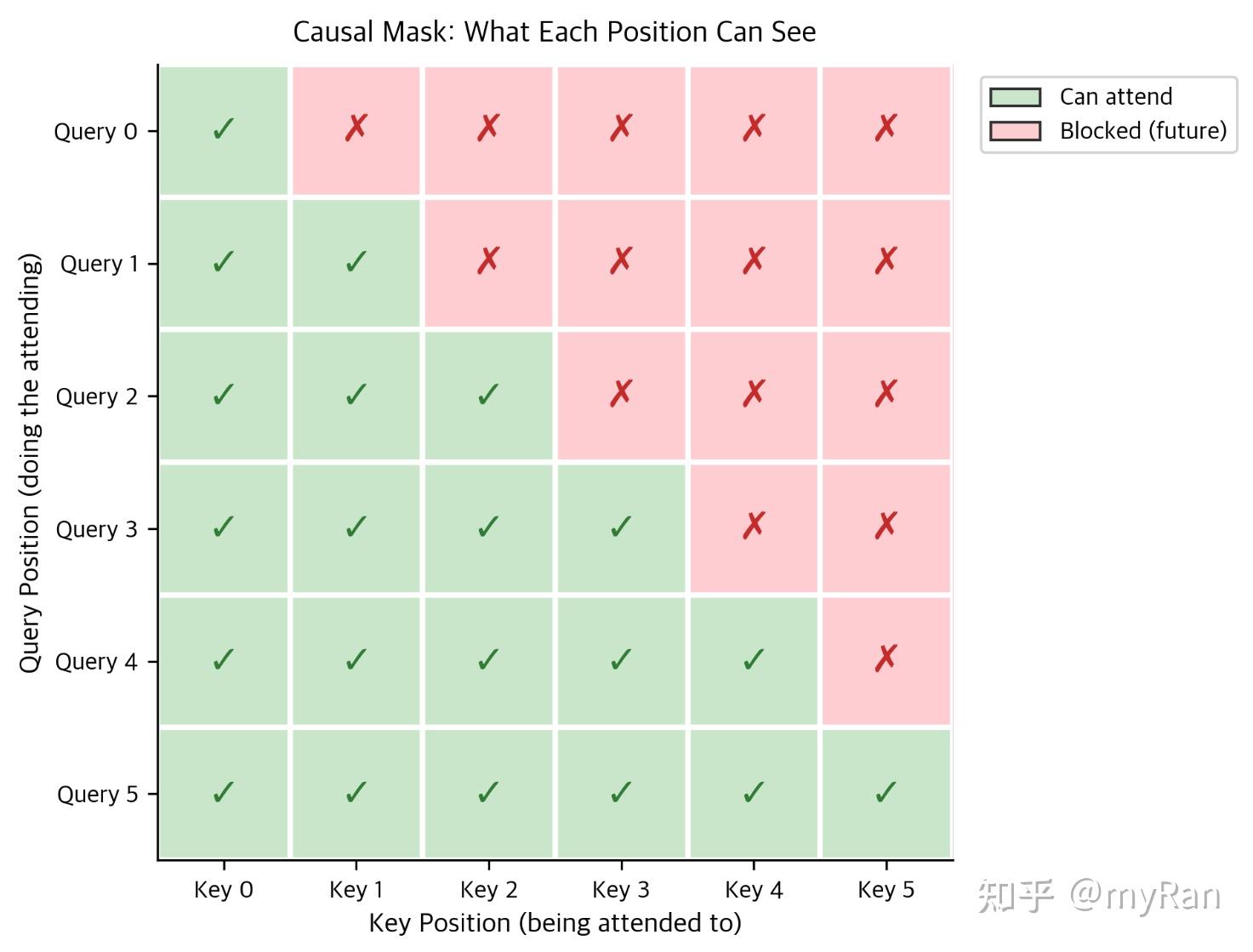
主对角线以上全部mask
通过图片也能知晓如何生成对应的mask,具体代码如何请待下一篇文章。在目前的代码中,t_mask就是图片中所提及的causal mask。
Cross Attention
这部分将Encoder的编码信息和目前已生成的词向量信息相结合,值得一提的是,我们只需要从Encoder中获取 \(K,V\) ,而 \(Q\) 是Decoder自身的词向量信息。从此处也能够解释为什么只有KV cache,而无Q cache。不缓存Q是因为Q只在当前token一次性使用,而KV是长期可以复用的历史信息,缓存KV能够避免重复计算、将复杂度从 \(O(n^2)\) 降低至 \(O(n)\) 。另外,Q的计算仅依赖当前的token embedding,开销小;KV需要对历史所有token做线性投影,开销大。
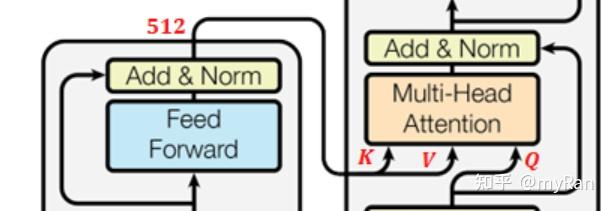
Cross-Attentio中的Q,K,V顺序
Encoder负责理解输入句子,Decoder负责生成输出句子,cross-attention将二者进行对齐。
剩下部分在前面文章中已做讲解,此处不再赘述。
Decoder
先展示代码:
# 2. Decoder
class Decoder(nn.Module):
    """
    Input: (B, L)
    Output: (B, L, D)
    """
    def __init__(self, vocab_size: int, d_model: int, max_len: int, n_head: int, hidden: int, n_layer: int, dropout: float = 0.1):
        super().__init__()

        self.embedding = TransformerEmbedding(vocab_size, d_model, max_len, dropout)

        self.layers = nn.ModuleList(
            [DecoderLayer(d_model, n_head, hidden, dropout) for _ in range(n_layer)]
        )

    def forward(self, enc_x: torch.Tensor, dec_tokens: torch.Tensor, t_mask: torch.Tensor, s_mask: torch.Tensor) -> torch.Tensor:
        # enc_x: (B, L, D)
        # dec_tokens: (B, L)
        dec_x = self.embedding(dec_tokens)

        for layer in self.layers:
            dec_x = layer(enc_x, dec_x, t_mask, s_mask)
        return dec_x
Decoder的任务很简单,就是把前面的Embedding与堆叠的DecoderLayer进行组装。
由于目前还未讲解如何构造mask张量,以及Decoder的测试涉及到多个模块,我们将在下一篇Transformer组装中进行测试,并完成一个简单训练任务。