
PBKDF2
原文链接:https://www.yuque.com/yangguangfanxing/zuyi8o/axkfbqllfgribhpu
PBKDF2 is a simple cryptographic key derivation function, which is resistant to dictionary attacks and rainbow table attacks. It is based on iteratively deriving HMAC many times with some padding. The PBKDF2 algorithm is described in the Internet standard RFC 2898 (PKCS #5).
PBKDF2 takes several input parameters and produces the derived key as output:
key = pbkdf2(password, salt, iterations-count, hash-function, derived-key-len)Technically, the input data for PBKDF2 consists of:
password– array of bytes / string, e.g. "p@$Sw0rD~3" (8-10 chars minimal length is recommended)salt– securely-generated random bytes, e.g. "df1f2d3f4d77ac66e9c5a6c3d8f921b6" (minimum 64 bits, 128 bits is recommended)iterations-count, e.g. 1024 iterationshash-functionfor calculating HMAC, e.g. SHA256derived-key-lenfor the output, e.g. 32 bytes (256 bits)
The output data is the derived key of requested length (e.g. 256 bits).
PBKDF2 and Number of Iterations
PBKDF2 allows to configure the number of iterations and thus to configure the time required to derive the key.
- Slower key derivation means high login time / slower decryption / etc. and higher resistance to password cracking attacks.
- Faster key derivation means short login time / faster decryption / etc. and lower resistance to password cracking attacks.
- PBKDF2 is not resistant to GPU attacks (parallel password cracking using video cards) and to ASIC attacks (specialized password cracking hardware). This is the main motivation behind more modern KDF functions.
PBKDF2 - Example
Try PBKDF2 key derivation online here: https://asecuritysite.com/encryption/PBKDF2z.
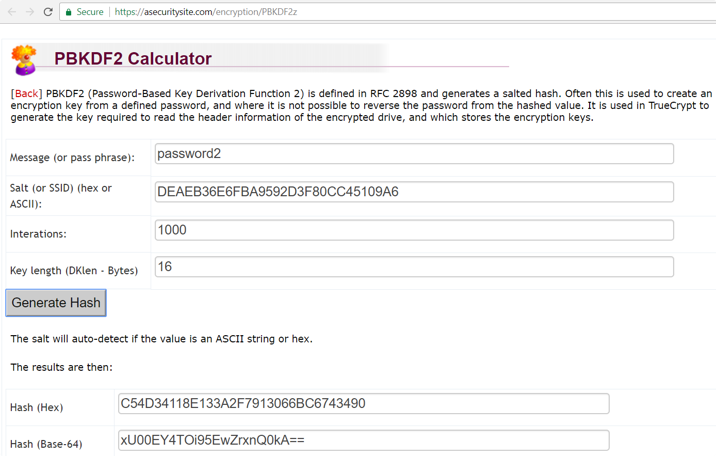
Try to increase the iterations count to see how this affects the speed of key derivation.
PBKDF2 Calculation in Python - Example
Now, we shall write some code in Python to derive a key from a password using the PBKDF2 algorithm.
Firstly, install the Python package backports.pbkdf2 using the command:
pip install backports.pbkdf2Now, write the Python code to calculate PBKDF2:
import os, binascii
from backports.pbkdf2 import pbkdf2_hmac

salt = binascii.unhexlify('aaef2d3f4d77ac66e9c5a6c3d8f921d1')
passwd ="p@$Sw0rD~1".encode("utf8")
key = pbkdf2_hmac("sha256", passwd, salt,50000,32)
print("Derived key:", binascii.hexlify(key))
Run the above code example: https://repl.it/@nakov/PBKDF2-in-Python.
The PBKDF2 calculation function takes several input parameters: hash function for the HMAC, the password (bytes sequence), the salt (bytes sequence), iterations count and the output key length (number of bytes for the derived key).
The output from the above code execution is the following:
Derived key: b'52c5efa16e7022859051b1dec28bc65d9696a3005d0f97e506c42843bc3bdbc0'Try to change the number of iterations and see whether and how the execution time changes.
When to Use PBKDF2?
Today PBKDF2 is considered old-fashioned and less secure than modern KDF functions, so it is recommended to use Bcrypt, Scrypt or Argon2 instead. We shall explain all these KDF functions in details later in this section.
Modern Key Derivation Functions
PBKDF2 has a major weakness: it is not GPU-resistant and not ASIC-resistant, because it uses relatively small amount of RAM and can be efficiently implemented on GPU (graphics cards) or ASIC (specialized hardware).
Modern key-derivation functions (KDF) like Scrypt and Argon2 are designed to be resistant to dictionary attacks, GPU attacks and ASIC attacks. These functions derive a key (of fixed length) from a password (text) and need a lot memory (RAM), which does not allow fast parallel computations on GPU or ASIC hardware.
Algorithms like Bcrypt, Scrypt and Argon2 are considered more secure KDF functions. They use salt + many iterations + a lot of CPU + a lot of RAM memory and this makes very hard to design a custom hardware to significantly speed up password cracking.
It takes a lot of CPU time to derive the key (e.g. 0.2 sec) + a lot of RAM memory (e.g. 1GB). The calculation process is memory-dependent, so the memory access is the bottleneck of the calculations. Faster RAM access will speed-up the calculations.
When a lot of CPU and RAM is used to derive the key from given password, cracking passwords is slow and inefficient (e.g. 5-10 attempts / second), even when using very good password cracking hardware and software. The goal of the modern KDF functions is to make practically infeasible to perform a brute-force attack to reverse the password from its hash.
Let's discuss in more details Scrypt, Bcrypt and Argon2.