
ECIES Hybrid Encryption Scheme
原文链接:https://www.yuque.com/yangguangfanxing/zuyi8o/hivx0pm0bgqdovoz
A hybrid encryption scheme similar to the previously demonstrated code is standardized under the name Elliptic Curve Integrated Encryption Scheme (ECIES) in many crypto standards like SECG SEC-1, ISO/IEC 18033-2, IEEE 1363a and ANSI X9.63. ECIES is a public-key authenticated encryption scheme, which works similarly to the above code examples, but uses a KDF (key-derivation function) for deriving separate MAC key and symmetric encryption key from the ECDH shared secret. It has many variants.
The ECIES standard combines ECC-based asymmetric cryptography with symmetric ciphers to provide data encryption by EC private key and decryption by the corresponding EC public key. The ECIES encryption scheme uses ECC cryptography (public key cryptosystem) + key-derivation function (KDF) + symmetric encryption algorithm + MAC algorithm, combined together like it is shown on the figure below:
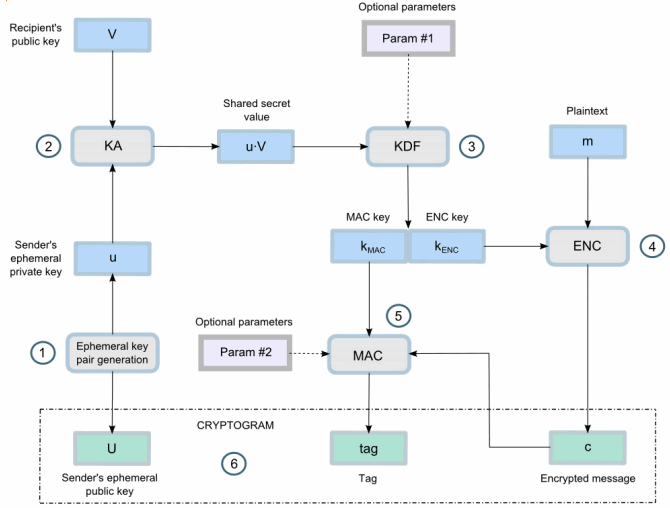
The input of the ECIES encryption consists of recipient's public key + plain text message. The output consists of sender's ephemeral public key (ciphertext public key) + encrypted message (ciphertext + symmetric algorithm parameters) + authentication tag (MAC code):
ECIES-encrypt(recipientPublicKey, plaintextMessage)➔{ cipherTextPublicKey, encryptedMessage, authTag }
The ECIES decryption takes the output from the encryption + the recipient's private key and produces the original plaintext message or detects a problem (e.g. integrity / authentication error):
ECIES-decrypt(cipherTextPublicKey, encryptedMessage, authTag, recipientPrivateKey, )➔ plaintextMessage
The ECIES encryption scheme is a framework, not a concrete algorithm. It can be implemented by plugging different algorithms, e.g. the secp256k1 or P-521 elliptic curve for the public-key calculations + PBKDF2 or Scrypt for KDF function + AES-CTR or AES-GCM or ChaCha20-Poly1305 for symmetric cipher and authentication tag + HMAC-SHA512 for MAC algorithm (in case of unauthenticated encryption).
In the next section we shall demonstrate through a code example how to use ECIES in practice.
ECIES Encryption - Example
Now, let's demonstrate how the ECIES encryption scheme works in practice in Python. We shall use a Python library eciespy:
pip install eciespyA sample Python code to generate public / private key pair and encrypt and decrypt a message using ECIES is:
from ecies.utils import generate_eth_key
from ecies import encrypt, decrypt
import binascii

privKey = generate_eth_key()
privKeyHex = privKey.to_hex()
pubKeyHex = privKey.public_key.to_hex()
print("Encryption public key:", pubKeyHex)
print("Decryption private key:", privKeyHex)

plaintext = b'Some plaintext for encryption'
print("Plaintext:", plaintext)

encrypted = encrypt(pubKeyHex, plaintext)
print("Encrypted:", binascii.hexlify(encrypted))

decrypted = decrypt(privKeyHex, encrypted)
print("Decrypted:", decrypted)
Run the above code example: https://repl.it/@nakov/ECIES-in-Python.
The above code is pretty simple: just generate ECC public + private key pair using ecies.utils.generate_eth_key() and call the ecies.encrypt(pubKey, msg) and decrypt(privKey, encryptedMsg) functions from the eciespy library.
The output form the above code looks like this:
Encryption public key: 0x0dc8e06c055b45ecf110258ed5c0261ce2019b1bd0f8f226dcd010dade448b8f304a0915c68cdf7ddded8e4021d28fb92e27d08df695f48a0d2c41ddee750fc7
Decryption private key: 0x487fd8b53c471e3c38484a0fbe4751ace67a9ed28e60ea6b0b44c445b881f99d
Plaintext: b'Some plaintext for encryption'
Encrypted: b'045699078bbd101e270572d0d68e87a8f7b6cc377ebeeffb60d2fcac5dc7bdd86a26d7f79d13b92e923a0e2cdbe418a7856b27157ef150d5c72f4f8f312467d13221ebe7049b7ed2f0ed253bce13117129a7b01bb881b8dfbf004ff11f3ebed4c732744bc49ea03230c2d1b2ec80774e79c075431d2019464d3de97ceb96'
Decrypted: b'Some plaintext for encryption'
The Python eciespy library internally uses ECC cryptography over the secp256k1 curve + AES-256-GCM authenticated encryption. Note that the above encrypted message holds together 4 values: {cipherPubKey, AES-nonce, authTag, AES-ciphertext}, packed in binary form and not directly visible from the above output.